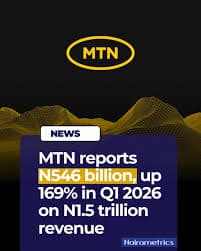
MTN Nigeria has reported a strong set of financial results for the first quarter of 2026, with service revenue climbing 41.8% year on year. For most people, this is just a headline from a telecoms giant. For anyone paying attention to Nigeria's digital infrastructure story, it is a signal worth unpacking.
What Is Driving the Growth
The revenue growth is being driven primarily by data and digital services rather than traditional voice. Nigerians are consuming more data, using more digital financial services, and increasingly conducting business through mobile and internet platforms. This is not a new trend — but the scale and pace of acceleration in 2026 is notable.
MTN's MoMo mobile money platform, which recently transferred its operations to a parent entity in a ₦95.5 billion transaction, is a significant part of this story. Mobile money is gradually filling the gaps that traditional banking has left open for millions of Nigerians — particularly outside Lagos and Abuja.
What It Means for Nigerian Businesses
When the country's largest telecoms operator grows at this pace, it creates both opportunity and obligation for Nigerian businesses. The opportunity: more Nigerians than ever are reachable digitally — as customers, as employees, and as partners. The obligation: your digital infrastructure needs to be ready to handle that reach.
A website that loads slowly on mobile, a payment system that drops transactions, or an IT infrastructure that cannot scale beyond ten concurrent users is not just an inconvenience — it is a competitive liability in a market moving this fast.
The AfDB's $200 Million Bet on Nigeria's Connectivity
Adding further context, the African Development Bank recently approved a $200 million loan towards Nigeria's Project Bridge — a fibre-optic programme aimed at expanding broadband access across the country. When fibre reaches more Nigerian cities and towns, the businesses that already have digital infrastructure in place will pull further ahead of those that do not.
The window to build that foundation is now, before connectivity catches up with ambition. Mandleva exists precisely to help Nigerian businesses build that foundation — properly, securely, and at a scale that can grow with the market.